
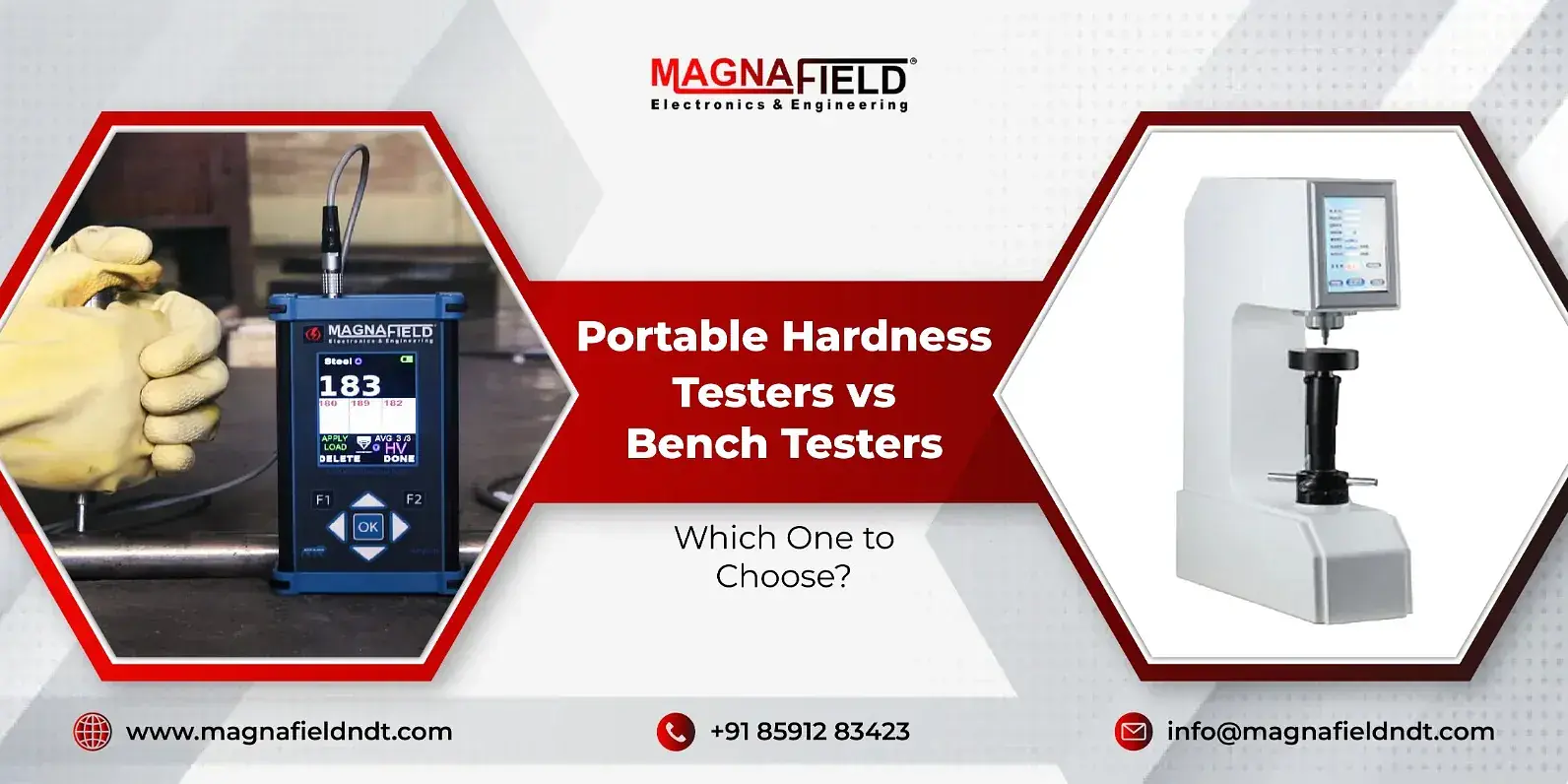
Portable Hardness Testers vs Bench Testers: Which One to Choose?
When it comes to hardness testing, one of the most common decisions engineers and quality professionals face is choosing between a portable hardness tester and a bench hardness tester. Both serve the same fundamental purpose — measuring a material's resistance to deformation — but they're built for very different working conditions. Making the right choice can significantly impact your testing efficiency, accuracy, and overall workflow.
So let's break it down clearly, without the jargon overload.
What Is a Portable Hardness Tester?
A portable hardness tester, as the name suggests, is a compact, handheld device designed for on-site or field hardness testing. These testers are lightweight, battery-operated, and capable of measuring hardness on large, heavy, or installed components that simply cannot be moved to a lab.
They are widely used across industries like oil & gas, power generation, aerospace, structural steel fabrication, and on-site weld inspection. Common methods used in portable testers include:
• Leeb (Rebound) method — the most popular for field use
• UCI (Ultrasonic Contact Impedance) method — ideal for thin-walled or small parts
• Combined methods — offering versatility in one device
At Magnafield NDT, our range of portable hardness testers is designed keeping the field professional in mind — rugged, easy to operate, and certified for accuracy. Whether you're working at a remote industrial site or inspecting welds post-fabrication, a portable tester keeps your workflow moving without dragging your workpiece back to the lab.
What Is a Bench Hardness Tester?
A bench hardness tester (also called a stationary or laboratory hardness tester) is a fixed machine installed in a workshop or quality control lab. It offers higher levels of precision and repeatability because it eliminates variables like operator movement, surface angle, and vibration — things that can affect field measurements.
These testers are commonly used for:
• Incoming material inspection in controlled environments
• Batch testing of small machined components
• R&D and metallurgical analysis
• Hardness testing where high accuracy and traceability are required
Bench testers typically support methods such as Rockwell, Brinell, Vickers, and Knoop. They are heavier, require a stable mounting surface, and cannot be used on installed structures or large components.
Portable Hardness Testers vs Bench Testers: A Side-by-Side Comparison
Here's a straightforward look at how these two types of hardness testers stack up against each other:
Portability: Portable testers win hands down. They are handheld and go wherever you go. Bench testers are fixed and not suitable for field use.
Accuracy: Bench testers generally offer higher precision under controlled conditions. However, modern portable testers — especially UCI-based ones — deliver excellent accuracy for most industrial applications.
Test Location: With a portable hardness tester, you can test components in-situ — pipelines, pressure vessels, turbine blades, structural beams — without dismantling anything. Bench testers require you to bring the sample to the machine.
Testing Methods: Bench testers offer a wider range of standard methods. Portable testers are more specialized but increasingly versatile thanks to combined-method devices.
Cost: Portable testers are generally more affordable upfront. Bench testers involve higher capital costs plus installation and dedicated workspace.
Ease of Use: Both are user-friendly in their own right, but portable testers require a little more operator skill to ensure consistent results in the field.
When Should You Choose a Portable Hardness Tester?
A portable hardness tester is the right choice when:
• You need to test large, heavy, or installed components that can't be moved
• Field inspections and on-site quality checks are part of your regular workflow
• You work in industries like oil & gas, power plants, shipbuilding, or infrastructure
• Speed and flexibility matter more than laboratory-grade precision
• Post-weld hardness testing is required at the point of fabrication
For professionals who are always on the move between job sites, a reliable portable hardness tester is not just convenient — it's essential.
When Should You Choose a Bench Hardness Tester?
A bench hardness tester makes more sense when:
• Your testing is primarily done in a controlled lab or workshop environment
• You're inspecting small, machined, or delicate components
• High precision, traceability, and documentation are mandatory
• Volume testing of batches is part of your quality process
• You follow strict ASTM or ISO standards requiring laboratory-grade equipment
If you're running a dedicated quality control department and your components come to you rather than the other way around, a bench tester is the smarter long-term investment.
Can You Use Both? Absolutely.
Many industries use both portable and bench hardness testers in complementary roles. The bench tester handles incoming material verification and batch inspection in the lab, while the portable tester covers field inspections, weld checks, and in-service component assessments.
If budget is a constraint, start by identifying where most of your testing actually happens. If 80% of your work is in the field — go portable. If it's mostly lab-based — go bench. And if you need both, it's worth investing in a combined-method portable tester that gives you the most flexibility from a single device.
At Magnafield NDT, we've been supplying high-quality NDT equipment and accessories since 2013 — proudly manufacturing in India and serving clients nationally and internationally. Our portable hardness testers are engineered to be energy-efficient, easy to operate, and built to last in the toughest industrial environments.
Conclusion
Choosing between a portable hardness tester and a bench hardness tester isn't about which one is better — it's about which one is right for your specific application. If your work demands flexibility, field access, and speed, a portable tester is your best ally. If precision, volume, and controlled conditions are your priority, a bench tester is the way to go.
The good news? With the right guidance and the right partner, you don't have to figure it out alone. Magnafield NDT is here to help you make an informed decision based on your industry, your components, and your quality goals.
Because when all is said and done, superior hardness testing goes beyond the instrument — it comes down to matching the right solution to the right challenge.