How NDT Equipment Improves Weld Quality in Fabrication Industries
In today's fabrication industries, weld quality is non-negotiable. Whether you're working in the oil and gas sector, structural steel, pressure vessels, or heavy machinery manufacturing, a single compromised weld can lead to catastrophic failures, costly recalls, or — most critically — life-threatening risks on the work floor. That's precisely why Non-Destructive Testing (NDT) has become a cornerstone of modern weld quality assurance. Unlike destructive testing methods that damage or consume the component, NDT equipment allows inspectors to evaluate welds from every angle without compromising the integrity of the finished part.
At Magnafield NDT, we've spent over a decade working with quality teams, inspection agencies, and fabrication plants to understand what it truly takes to achieve consistent, defect-free welds. In this article, we break down how the right NDT equipment directly contributes to improved weld quality and stronger fabrication outcomes.
Why Weld Quality Matters in Fabrication
Welding is the backbone of most fabrication processes. But it's also one of the most defect-prone operations in manufacturing. Porosity, incomplete fusion, undercuts, cracks, and slag inclusions — these aren't just textbook problems. They're real, common, and often invisible to the naked eye.
International standards such as AWS D1.1, ISO 5817, and ASME Section IX require rigorous weld inspection to ensure compliance. Fabrication companies that skip or under-invest in weld quality control face regulatory penalties, project delays, rework costs, and reputational damage. NDT equipment bridges the gap between welding execution and quality assurance, offering accurate, repeatable, and documented inspection results.
Key NDT Methods Used for Weld Inspection in Fabrication Industries
Different weld defects require different detection approaches. Here's how the primary NDT techniques contribute to weld quality improvement:
1. Magnetic Particle Inspection (MPI): Revealing Surface-Level and Near-Surface Weld Defects
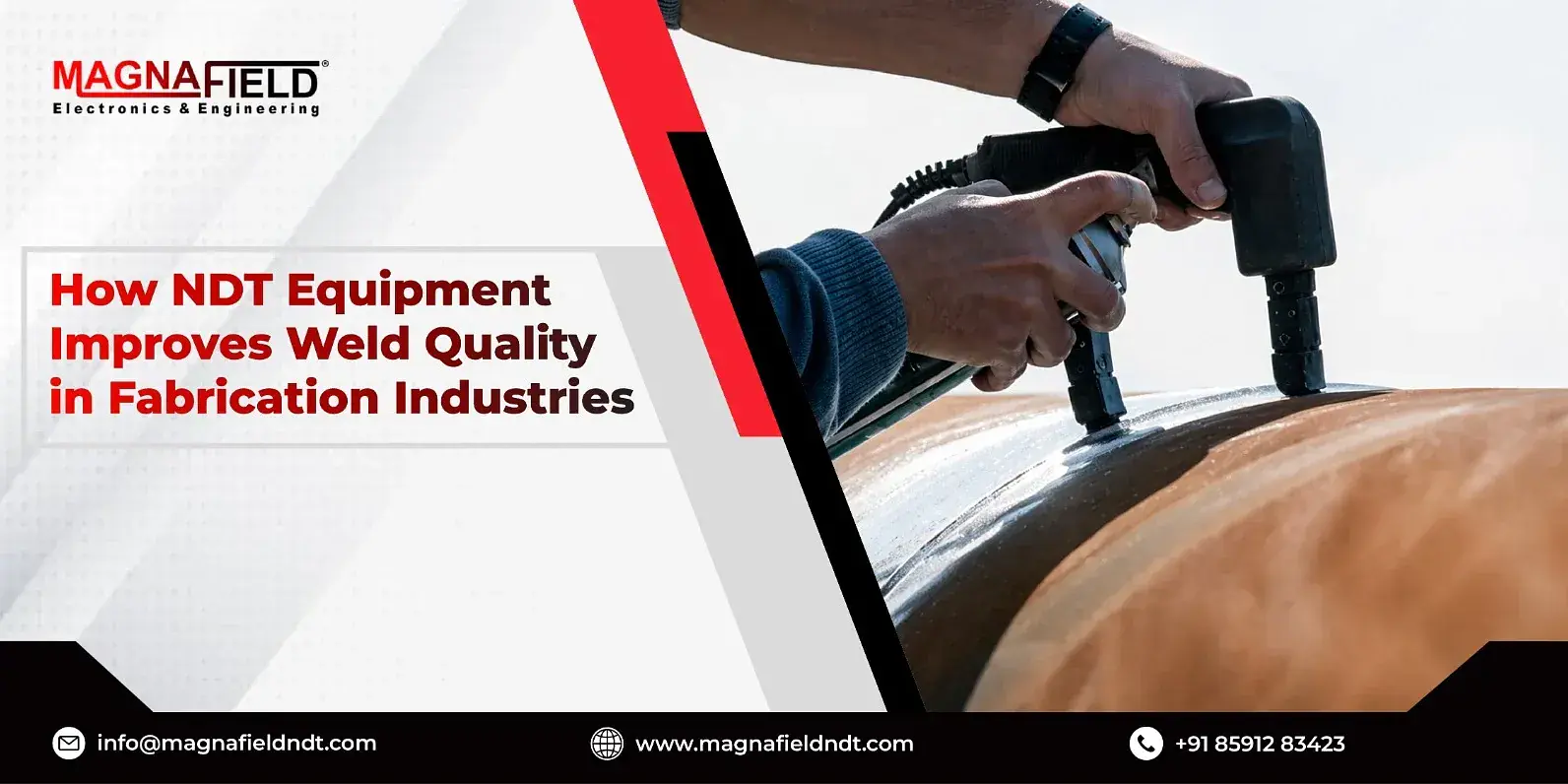
Magnetic Particle Inspection is one of the most widely used NDT methods for detecting surface-breaking and near-surface discontinuities in ferromagnetic weld joints. When a magnetic field is applied to the weld area, any surface crack or discontinuity disrupts the flux lines, causing magnetic particles to gather visibly at the defect site.
MPI yokes, MPI machines, and UV LED torches are the primary tools used in this process. Magnafield NDT's range of MPI equipment — including our YokeLite portable magnetic yoke and UltraBlaze UV LED torches — is designed for field use in fabrication environments, offering bright, consistent fluorescence even in high-ambient-light conditions. This makes it easier for inspectors to identify even hairline cracks in weld seams, heat-affected zones, and base materials.
2. Radiographic Testing (RT) — Internal Weld Flaw Detection
While MPI is excellent for surface defects, Radiographic Testing goes deeper — literally. Using X-rays or gamma rays, RT reveals internal weld discontinuities such as porosity clusters, lack of fusion, shrinkage cavities, and inclusions that are entirely hidden from the surface.
In fabrication industries dealing with high-pressure pipelines, boilers, and critical structural components, RT is a mandatory quality step. The resulting radiographic films are reviewed using RT film viewers and film densitometers to assess optical density and confirm compliance with acceptance criteria. Magnafield NDT supplies precision RT film viewers, densitometers, and a full range of RT accessories that enable accurate, standard-compliant radiographic weld evaluations.
3. Ultrasonic Testing (UT) — Thickness, Bond Integrity, and Volumetric Inspection
Ultrasonic Testing uses high-frequency sound waves to probe the internal structure of welds. Any discontinuity in the material bounces the sound waves back to the transducer, precisely mapping the flaw's position, dimensions, and direction. UT is especially valued in thick-section welds and components where RT is not practical.
UT probes, calibration blocks, and couplants are essential components of a reliable ultrasonic testing setup. Magnafield NDT's ultrasonic testing accessories — including UT blocks, cables, and high-sensitivity probes — are engineered to deliver stable, repeatable readings across a variety of weld geometries and material types.
4. Dye Penetrant Testing (DPT) — Cost-Effective Surface Crack Detection
Dye Penetrant Testing is a straightforward yet highly effective method for detecting open surface defects in both ferrous and non-ferrous weld joints. The penetrant is applied to the weld surface, allowed to seep into any cracks or discontinuities, and then revealed using a developer. The result is a clear, visible indication of surface flaws.
DPT is widely used in sheet metal fabrication, pipe welding, and aerospace components. Magnafield NDT provides dye penetrant consumables that meet industry-standard formulations, ensuring reliable indication contrast and minimal false positives during weld quality inspections.
How NDT Equipment Directly Improves Weld Quality
Using quality NDT equipment translates into tangible improvements across the fabrication workflow. Here's how:
• Early Defect Detection: Identifying weld discontinuities at the in-process stage — not post-installation — drastically reduces rework costs and prevents structural failures downstream.
• Consistent Inspection Records: Modern NDT tools enable documented, repeatable inspections that satisfy audit requirements and quality management systems such as ISO 9001 and API Q1.
• Welder Performance Feedback: Regular NDT of weld samples creates a feedback loop for welding teams — helping identify technique issues, incorrect parameters, or material incompatibilities before they become systemic problems.
• Regulatory Compliance: Industries like petrochemical, power generation, and defense mandate NDT as part of welding procedure qualifications (WPQ). Reliable NDT equipment ensures compliance without production delays.
• Reduced Lifecycle Costs: Catching a weld defect at the fabrication stage costs a fraction of what it takes to repair or replace a failed component in the field. A good NDT setup recoups its cost several times over its service life.
Choosing the Right NDT Equipment for Weld Inspection
Not all NDT equipment is created equal. Fabrication environments are demanding — high temperatures, rough surfaces, outdoor conditions, and time-sensitive production schedules require tools that are built tough, easy to use, and deliver accurate results every time.
When evaluating NDT equipment for weld quality applications, look for instruments that offer:
• Portability and ease of use for on-site weld inspections
• Compliance with applicable standards (ASTM, ISO, EN, ASME)
• Rugged construction for harsh fabrication environments
• Low maintenance and long service life
• Availability of consumables and technical support
Magnafield Electronics and Engineering Pvt. Ltd., based in Navi Mumbai, has been designing and supplying NDT equipment tailored to the rigorous demands of fabrication industries since 2013. Every product in the Magnafield NDT lineup — from MPI yokes and UV torches to RT film viewers, densitometers, hardness testers, and UT accessories — is built with the inspector's field experience in mind, delivering energy efficiency, durability, and precision in every inspection.
Conclusion
Weld quality in fabrication industries is not something that can be left to chance or visual inspection alone. The structural integrity of every pipeline, pressure vessel, bridge, and industrial frame depends on what lies beneath the surface of each weld joint. That's where NDT equipment becomes not just a tool, but a vital safeguard.
By integrating methods like Magnetic Particle Inspection, Radiographic Testing, Ultrasonic Testing, and Dye Penetrant Testing into your fabrication quality process, you gain the confidence that every weld you pass meets the standards it was designed to meet. The result? Fewer failures, lower rework costs, stronger client relationships, and a fabrication operation that stands behind its work.
Magnafield NDT continues to be a trusted partner for fabrication companies across India and internationally — providing the NDT equipment, accessories, and technical support that quality-focused teams depend on. If improving weld quality is on your agenda, the right NDT tools are the place to start.